
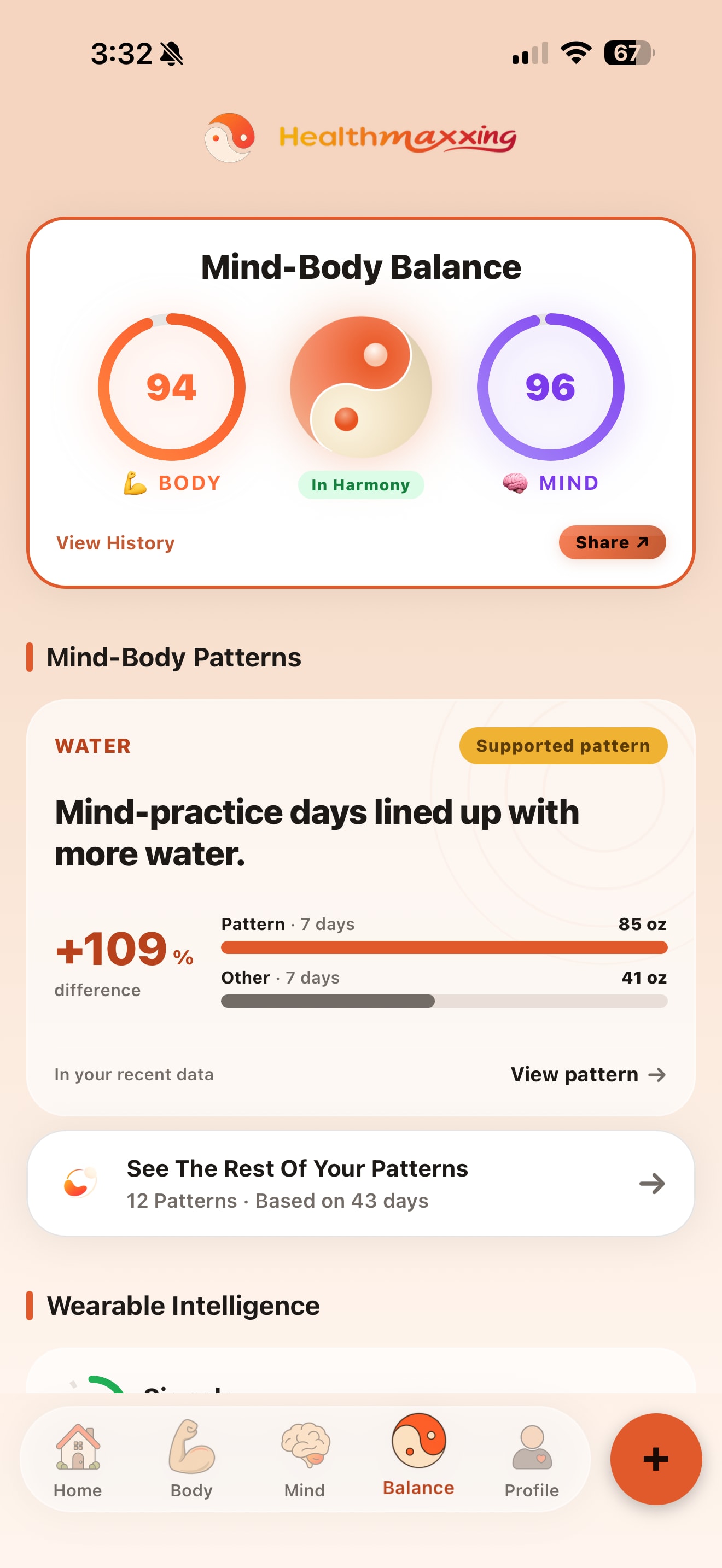
A holistic health tracker app should be built to support habits you can keep. The goal is practical understanding across behavior and context, not maximal control.
Why people ask for a tracker app
Most people begin with one focused tool and grow to more tools as needs widen. The mismatch is that wider needs become hard to connect. A holistic tracker app reduces that mismatch by giving a single timeline.
Signals to track first
| Signal type | Why track it | When to collect it |
|---|---|---|
| Sleep | Context for recovery and next-day behavior | Nightly and morning review |
| Nutrition | Fuel context without over-detail | Before or after meals |
| Movement | Physical stress and energy markers | Daily workout or activity |
| Mood and notes | Explains why metrics vary | Evening quick check-in |
How this design avoids overwhelm
HealthMaxxing separates measurement from interpretation. First, you collect a small set of signals. Then you run one question against them. This sequence lowers the chance of overfitting noise.
- One timeline across all lanes.
- One baseline period before conclusions.
- One interpretation frame per review cycle.
How this compares with specialist apps
Specialist apps remain useful for deep domain workflows. A holistic health tracker app sits above them as a coordination layer for daily behavior and context.
Use both when needed: specialist depth for complex needs, plus one tracker for daily synthesis.
Start with a weekly cadence
- Log five signals. Keep the set stable for one week.
- Review one relationship. For example sleep and next-day mood.
- Validate a second window. Repeat once with at least one correction to routine.
- Scale slowly. Add one category only after consistency holds.