
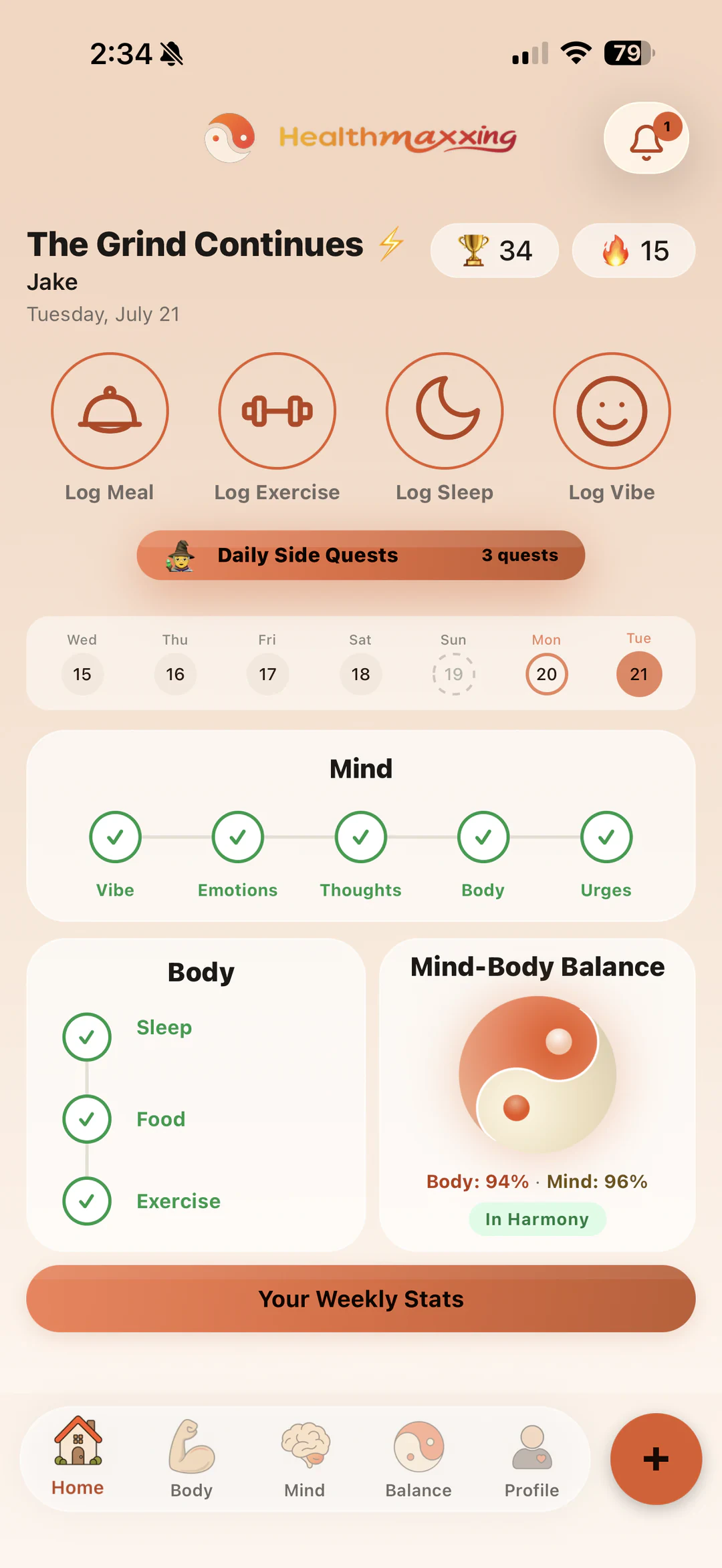
For people new to integrated tracking, a holistic app is not about everything at once. It is about the smallest useful set of body and mind signals recorded in one timeline.
What a holistic app means here
In this context, holistic means connected, not vague. The app captures multiple categories and keeps their timing in one place so review feels coherent. That means a sleep event can sit beside your next-day mood and meal pattern instead of living in separate places.
- Connected: categories are related through a shared day timeline.
- Practical: enough structure to track progress, not enough friction to quit quickly.
- Limited by design: no claim of deep clinical certainty from wellness data alone.
The problem a holistic app solves
Fragmented stacks are common because each app has strengths. The cost is context switching, re-entry friction, and repeated manual interpretation. A practical holistic app lowers those costs while staying honest about what the data cannot prove.
| Use case | What fragments | How one timeline helps |
|---|---|---|
| Sleep and energy questions | Sleep app and workout app | One screen for the sequence and surrounding context |
| Stress and routines | Journal tool and mood app | Context stays linked to day-level behavior |
| Nutrition and readiness | Food tracker and habit list | Review intake with training and readiness signals |
When one holistic app is the right choice
- When daily logging is your use case and your goal is pattern awareness.
- When you need one place to export and review your own data.
- When specialist depth is useful but not the daily default.
- When you want a practical baseline before adding more tools.
What it does not replace
Most people still need specialist tools for very specific areas, and some decisions still require clinician input. A holistic app should be a clear consumer entry point, not a clinical gateway.
Safety boundary: HealthMaxxing is a wellness app, not a medical device, treatment, or crisis-support system.
How to get started in 7 days
- Pick one main outcome. For example mood clarity or sleep consistency.
- Pick 4 to 6 inputs. Keep it small: sleep, movement, food, hydration, and one subjective input.
- Log for 7 days. Do not optimize before baseline data appears.
- Ask one question. For example, "When sleep improved, did next-day energy trend better?"