
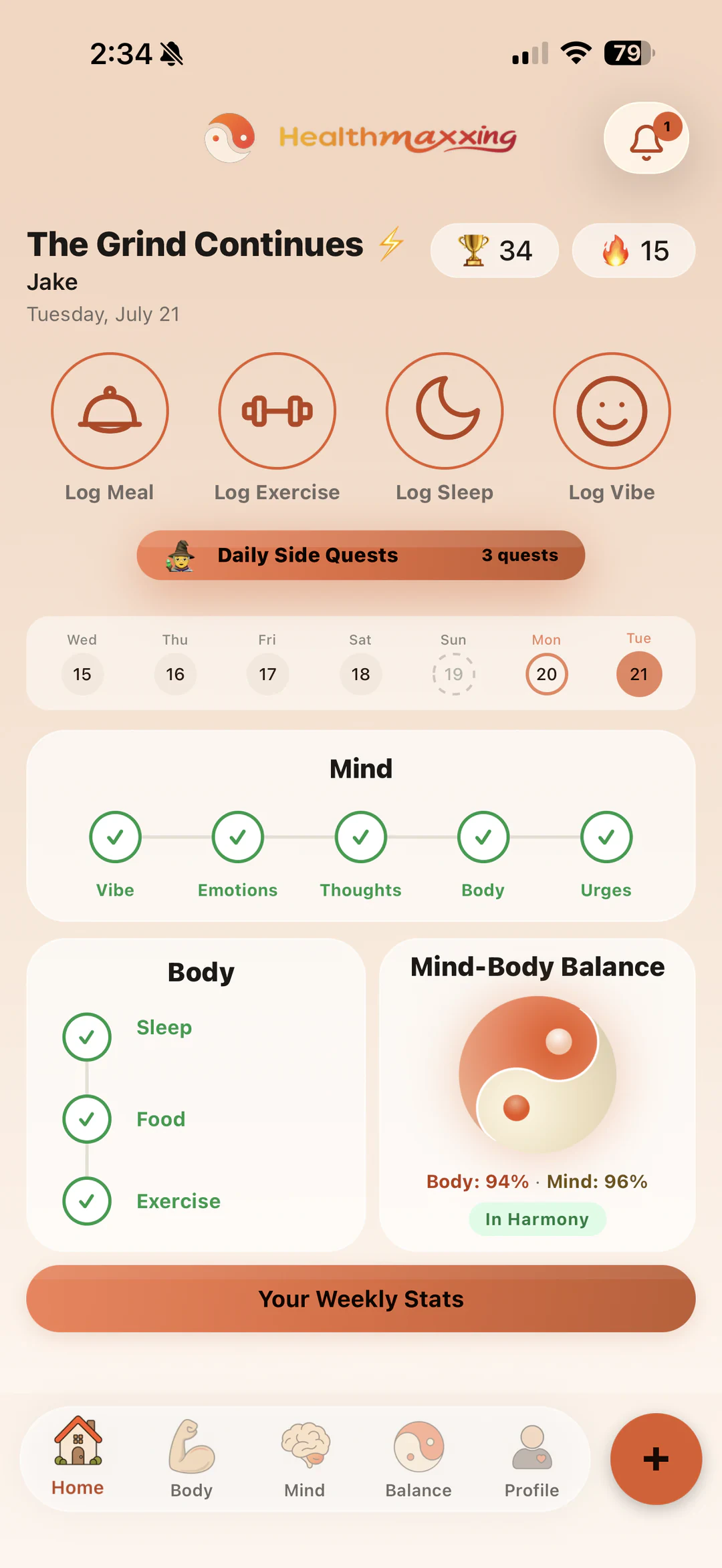
An all-in-one wellness app reduces the friction of keeping related daily signals in separate places. It is most useful when you want a broad, consistent overview. It is less useful when a specialized sport, condition, or clinical workflow requires deeper tools than a general wellness product should provide.
The real cost of a four-app stack
Separate apps can be excellent at their specialties. The problem appears when the question crosses categories. A food tracker may not know how you slept. A meditation app may not know whether you exercised. A wearable dashboard may record movement and sleep but miss the meal, mood, or journal context that made the day unusual.
That fragmentation costs more than subscription money. It creates repeated setup, duplicated logging, inconsistent date boundaries, and manual export work. Most importantly, it makes it harder to review the day as one sequence.
What HealthMaxxing includes
| Area | What you can track or use | Why it belongs together |
|---|---|---|
| Nutrition | Food, calories, macros, AI-assisted meal tools | Fuel can be reviewed beside activity, sleep, and mood |
| Fitness | Exercise, steps, compatible wearable imports | Movement stays connected to recovery and daily context |
| Sleep | Duration, sleep scores, calendar view | Sleep can be compared with next-day entries |
| Mind | Mood, journaling, breathing, calm tools | Subjective experience is not left outside the dashboard |
| Habits | Hydration, streaks, badges, side quests | Daily actions remain visible without guilt-based penalties |
All-in-one versus specialized apps
Choose an all-in-one app when continuity matters more than maximum depth in one category. Choose a specialized app when you need sport-specific programming, detailed clinical management, a regulated device workflow, or a feature HealthMaxxing does not claim to provide. A sensible stack may still include one specialist tool connected through Apple Health while HealthMaxxing serves as the broader daily context.
- All-in-one strength: fewer handoffs and a more coherent daily timeline.
- All-in-one limitation: it cannot be the deepest possible tool in every category.
- Specialist strength: focused workflows and domain-specific depth.
- Specialist limitation: the rest of the day may disappear from view.
From collection to useful questions
A combined record makes cross-category questions possible, but it does not make the answer automatically true. HealthMaxxing starts checking after seven logged days, and many relationships need around 10–14 relevant days or longer. Candidate patterns remain correlations, with the limitations described in the methodology.
The best question is specific and time-ordered: “On nights with more sleep, how did I usually rate next-day mood?” The worst question asks a dashboard to explain your health from every available metric at once.
Start without tracking everything
- Choose one outcome. Mood, energy, sleep quality, or consistency is enough.
- Add three supporting signals. For example: sleep, movement, meals, and the chosen outcome.
- Log for seven ordinary days. Avoid changing your whole routine during the baseline.
- Review one relationship. Keep notes about missing days and unusual context.
The free seven-day guide and template can be used with or without the app.
Current product fit
HealthMaxxing is coming soon to iPhone and Android. Core tracking will be free at launch, with optional Pro features available in the app. It is a consumer wellness app, not a medical device, therapy service, or emergency resource.
Transparent comparison: features and prices vary across individual apps and tiers. See the category-level comparison and correction policy for the definitions behind HealthMaxxing’s public comparisons.