
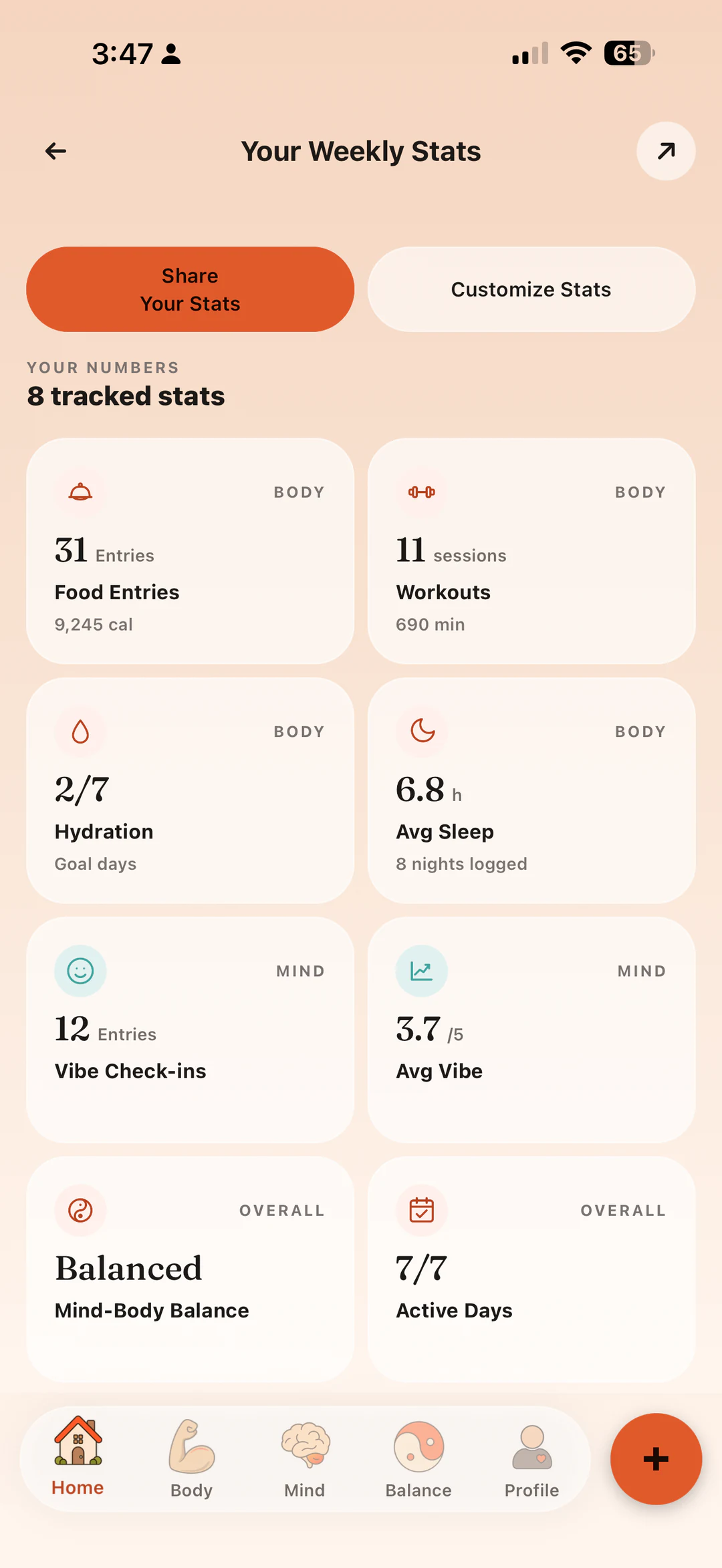
Compare health tracking apps across six dimensions: scope, logging effort, integrations, interpretation, privacy and safety, and total cost. Start with the decision you want the app to support. A narrower specialist may be the better choice; an all-in-one app may be better when the question crosses food, movement, sleep, and mood.
Six comparison criteria
| Criterion | Question to ask | Warning sign |
|---|---|---|
| Scope | Does it cover the signals relevant to my actual goal? | Many unrelated features with no coherent workflow |
| Logging effort | Can I keep this up on a busy day? | Insight requires dozens of daily fields |
| Integrations | Can it use compatible data I already collect? | Broad permission requests with little explanation |
| Interpretation | Does it distinguish observation from causation? | Diagnosis-like language from ordinary wellness logs |
| Privacy and safety | Are data use, deletion, and limits easy to find? | Vague policies or hidden sharing |
| Cost | What remains useful without a subscription? | Essential terms appear only after a long setup |
Four common app categories
Food and fitness trackers
Strong when calories, macros, workouts, or training consistency are the main job. Check whether sleep, mood, reflection, and wearable data are first-class signals or secondary add-ons.
Meditation and mental wellness apps
Strong when guided practices, breathing, or reflective tools are the main job. Check whether physical behaviors are connected to the experience or remain outside the product.
Wearable dashboards
Strong for passively collected movement, sleep, recovery, and device-specific metrics. Check how easily you can add meals, subjective mood, energy, and narrative context.
All-in-one wellness apps
Strong when you want a coherent daily record across several categories. Check whether breadth comes with usable workflows and honest limits rather than shallow feature duplication.
Questions to answer before downloading
- What is the primary question? “How do I train for a marathon?” and “How do food, sleep, and mood fit together?” require different products.
- What will I actually log? Choose a workflow that survives travel, work, and imperfect days.
- Which data should be automatic? Wearable import can reduce typing, but only if permissions and source limitations are clear.
- How will the app phrase uncertainty? Prefer descriptive language and visible limitations.
- How do I leave? Find export, deletion, and subscription controls before investing months of data.
HealthMaxxing’s transparent fit
- Best fit
- Food, fitness, sleep, hydration, mood, and reflection together
- Platform
- iPhone and Android coming soon
- Pattern timing
- Checks begin after 7 logged days; many need 10–14 relevant days or longer
- Medical status
- Consumer wellness app, not a medical device
HealthMaxxing is a strong fit for someone who wants both Body and Mind tracking in one app, optional Apple Health context, and personal pattern observations with explicit limits. A dedicated training platform, condition-specific tool, licensed therapy service, or clinical device may be the better choice for needs outside that scope.
Core tracking is free. Pro adds optional advanced features, including additional AI-supported analysis. Current price, billing period, renewal, and trial terms appear in the applicable App Store storefront and in the app before purchase.
How to read comparison claims
App features change by platform, region, plan, and release. A fair comparison states the review date, compares like with like, avoids cherry-picking a competitor’s weakest tier, and provides a correction path. HealthMaxxing’s public matrix compares categories rather than pretending every app within a category is identical.
Correction policy: The feature comparison includes definitions, scope, and a correction email. The research standards page separately states what HealthMaxxing has and has not validated.
A simple decision rule
Pick the narrowest app that completely supports your real goal. If one category is all you need, choose depth. If the useful question crosses categories—and you are tired of exporting and reconciling several tools—choose an all-in-one workflow with clear privacy and interpretation limits.
Health decisions deserve more than a comparison page. Apps can organize wellness data. They should not be used to delay care, change medication, or self-diagnose a concerning symptom.