
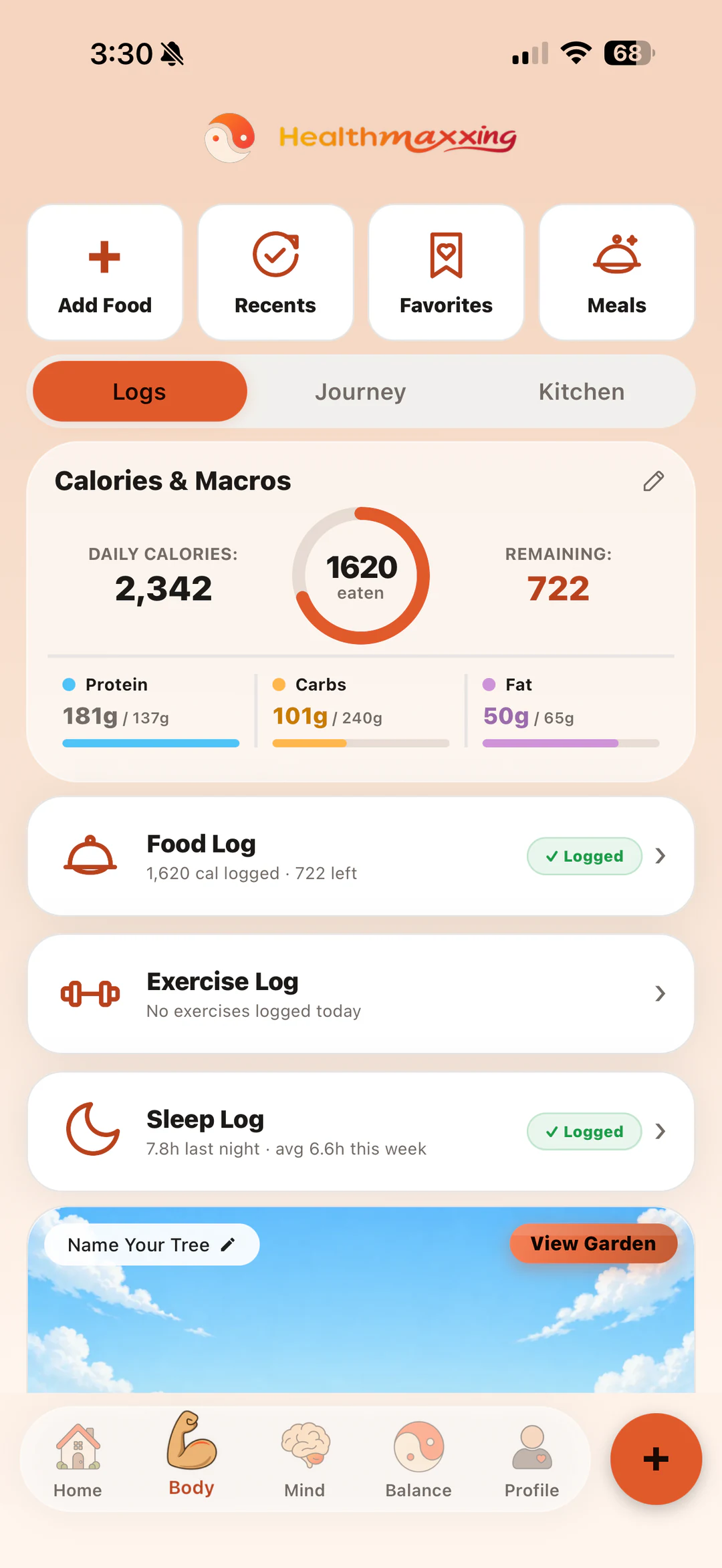
Whole-self health tracking means recording a small set of body, behavior, and mind signals in the same place. The point is not to measure everything. It is to preserve enough context to ask better questions about your own routine without turning a correlation into a diagnosis or a universal rule.
What “whole-self” means here
The National Center for Complementary and Integrative Health describes whole-person health as looking beyond isolated organs or systems and considering multiple interconnected factors. HealthMaxxing applies a narrower, consumer-wellness version of that idea: it lets you view the daily behaviors and reflections you choose to track without claiming to deliver clinical whole-person care.
That distinction matters. A wellness app can help organize a record, reduce fragmented logging, and surface observations. It cannot diagnose why you feel a certain way, determine whether a symptom is serious, or replace an appropriate healthcare professional.
What HealthMaxxing keeps together
Body
Food and macros, hydration, workouts, sleep, weight, and compatible data you choose to import from Apple Health.
Mind
Mood check-ins, journaling, reflection, breathing, and calm tools that add context a fitness-only dashboard often misses.
The shared view is the useful part. A night of sleep can sit beside next-day mood. A workout can be considered alongside energy. A meal log can remain connected to the rest of the day instead of living in a separate subscription and export file.
What a pattern can tell you
HealthMaxxing starts checking for candidate patterns after seven logged days. Many questions need around 10–14 relevant days, and some will need longer. The result is an observation across your own record—for example, that two logged signals tended to move together—not proof that one caused the other.
- Use patterns to decide what is worth watching again.
- Check whether unusual days, travel, illness, stress, or missing logs could explain the result.
- Prefer a repeatable observation over a dramatic one-off.
- Keep medication, symptoms, and treatment decisions with qualified professionals.
A simple way to start
- Pick four to six signals. Choose the few inputs you can log consistently, such as sleep duration, meals, movement, hydration, mood, and energy.
- Build a seven-day baseline. Log normally before trying to optimize anything. Consistency is more useful than false precision.
- Review one question. Compare two signals with a sensible time order, such as sleep followed by next-day mood.
- Repeat before acting. Treat a possible relationship as a prompt for another week of observation or a low-risk experiment.
Who this approach fits
Whole-self tracking is a strong fit if you currently juggle several wellness apps, want both quantitative and reflective logs, or already have Apple Health data but need more context around how you felt and what you did. A specialized app may still be better when you need a deep sport-specific training plan, condition-specific medical management, or clinician-directed monitoring.
Safety boundary: HealthMaxxing is a wellness app, not a medical device. Stop tracking if it becomes distressing or compulsive. New, severe, persistent, or concerning symptoms deserve appropriate care.